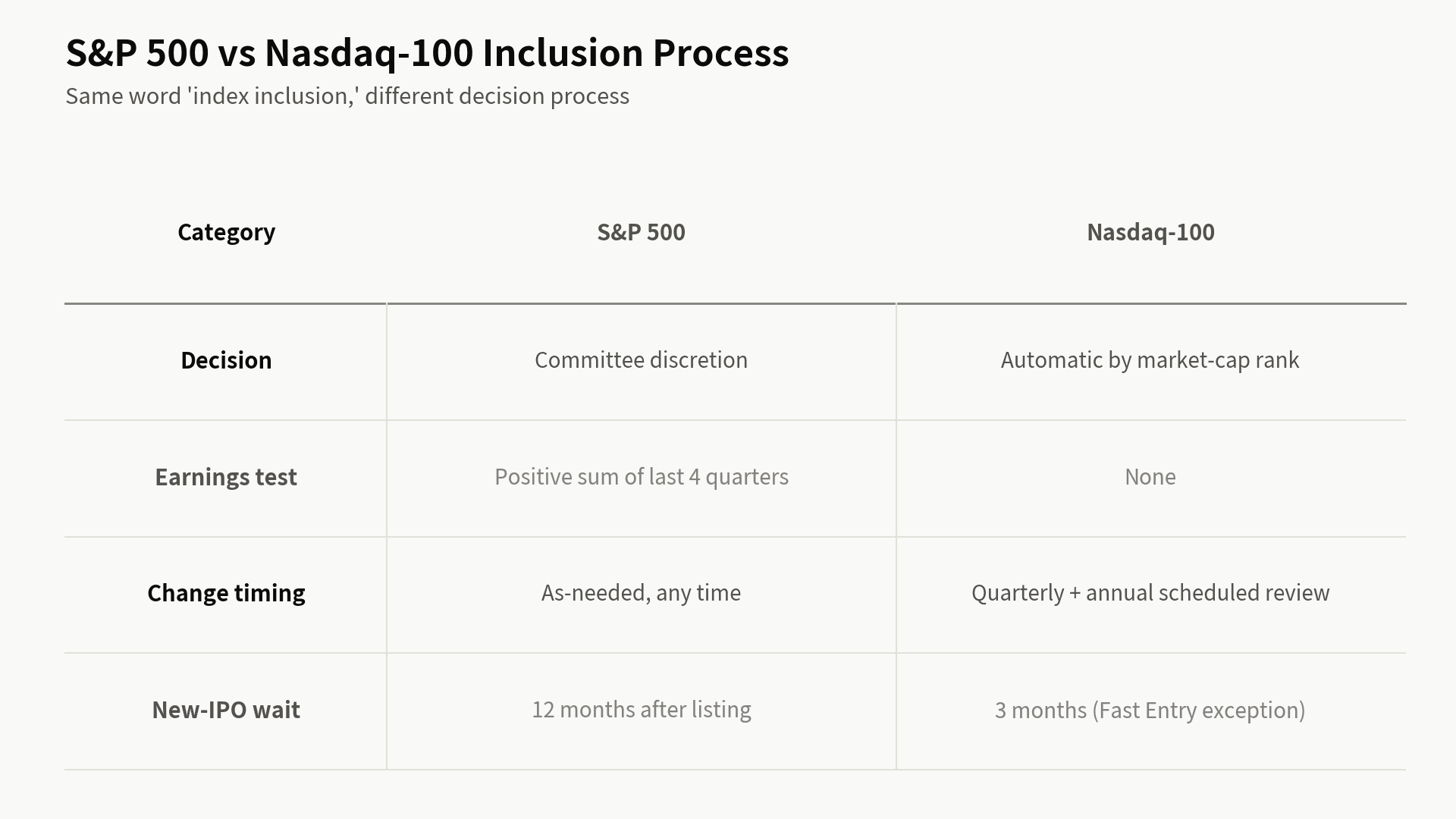
The S&P 500 inclusion criteria don’t work like a formula the way the Nasdaq-100’s do. A candidate needs a market cap of at least $22.7 billion, plus a float and liquidity screen, but passing those tests doesn’t guarantee a seat. The final call belongs to S&P Dow Jones Indices’ index committee, which can pick and choose among eligible companies, and removals happen whenever the committee decides, not on a fixed quarterly calendar.
What the S&P 500 inclusion criteria actually require on paper
According to the April 2026 S&P U.S. Indices methodology document, a company needs to clear several eligibility hurdles before it’s even considered. Market capitalization must be $22.7 billion or more, a threshold that’s reviewed quarterly to keep new entrants around the 85th percentile of the S&P Total Market Index universe. Float-adjusted market capitalization — the value of shares actually available to trade — must be at least 50% of that market-cap threshold at the security level.
Liquidity matters too. The float-adjusted liquidity ratio (annual dollar value traded divided by float-adjusted market cap) has to be 0.75 or higher at the time of addition, though existing constituents face no such ongoing requirement. The company must be U.S.-domiciled and listed on an eligible exchange such as the NYSE or Nasdaq Global Select Market, and only common stock in corporate form qualifies — REITs, MLPs, SPACs, and preferred shares are excluded.
There’s also a profitability test. Under the S&P Composite 1500 framework (which covers the S&P 500, S&P MidCap 400, and S&P SmallCap 600 together), GAAP net income from continuing operations must be positive for the most recent quarter and for the sum of the last four consecutive quarters. A company can be enormous and still get screened out by this rule alone if it isn’t profitable on that basis. Equity REITs get an exception: they can substitute funds from operations (FFO) for GAAP earnings.
A newly public company also has to trade on an eligible exchange for at least 12 months before it can even be considered. There’s no Nasdaq-100-style fast-track exception here — no matter how large an IPO is, it’s simply not eligible until that year has passed.
The biggest difference from Nasdaq-100: committee discretion
So far this sounds similar in spirit to the Nasdaq-100 inclusion rules. But there’s a critical difference. Nasdaq-100 mechanically fills its roster by market-cap rank among companies that clear its eligibility bar. The S&P 500 committee, by contrast, chooses among eligible candidates at its own discretion.
The committee also weighs sector balance, comparing each GICS sector’s weight in the index against that sector’s weight in the S&P Total Market Index within the relevant market-cap range. That means even when multiple candidates meet every numerical threshold, a sector that’s already overrepresented can lose out to a candidate from an underrepresented one. This discretion is exactly why the Nasdaq-100 assumption — “meet the criteria and you’re automatically in” — doesn’t carry over to the S&P 500.
Removals work differently too. There’s no scheduled quarterly review; changes happen on an as-needed basis whenever a company no longer meets the eligibility criteria, typically due to a merger, acquisition, or major restructuring, or when it substantially violates one of the standing requirements. A company removed from the index has to wait at least one year before it can be screened for readmission.
That said, media coverage often talks about “the March rebalance” or “the June rebalance” as if there’s a set schedule. There technically isn’t one for membership changes, but the index’s share-count and float updates do happen on a quarterly cycle, timed to the third Friday of March, June, September, and December. The committee frequently times new additions to coincide with those dates, which is why the quarterly framing sticks — even though, strictly speaking, an addition or removal driven by a merger can be announced at any point in between.
A real example: the June 2026 rebalance
In the rebalance announced on June 9, 2026 and effective before the market open on June 22, 2026, Marvell Technology (MRVL) and Flex (FLEX) joined the S&P 500. Marvell’s addition reflected its growing role in AI data-center infrastructure, particularly high-speed networking and connectivity chips, while Flex’s addition tracked continued strength in global electronics manufacturing and supply-chain infrastructure.
At the same time, Pool Corporation (POOL) and The Campbell’s Company (CPB) were removed from the S&P 500 and moved down to the S&P SmallCap 600. Neither company went bankrupt or was acquired — the change simply reflected that their market capitalization and market positioning were judged to fit better with a small-cap index than a large-cap one. That’s a useful reminder that the S&P 500 inclusion criteria can push a company out through relative decline alone, not just through outright failure.
What this means if you hold SPY or VOO
Understanding the S&P 500 inclusion criteria matters in practice for anyone holding SPY, VOO, or another fund that tracks the index. When a new addition is announced, index funds often need to buy shares between the announcement date and the effective date, which can create short-term buying pressure on the stock being added — and selling pressure on the one being removed. How much that actually moves the price depends on the stock’s liquidity and its target index weight.
It’s also worth remembering that, unlike the Nasdaq-100, the S&P 500 has no fixed rebalancing calendar for membership itself. Changes cluster around the third Friday of March, June, September, and December by convention, but the committee can announce additional changes at any time it judges necessary. The next thing to watch is the September 2026 rebalance announcement; the confirmed list will be posted at S&P Dow Jones Indices’ official site (spglobal.com/spdji). Whatever gets announced, it will be decided under the same S&P 500 inclusion criteria and committee discretion described above.