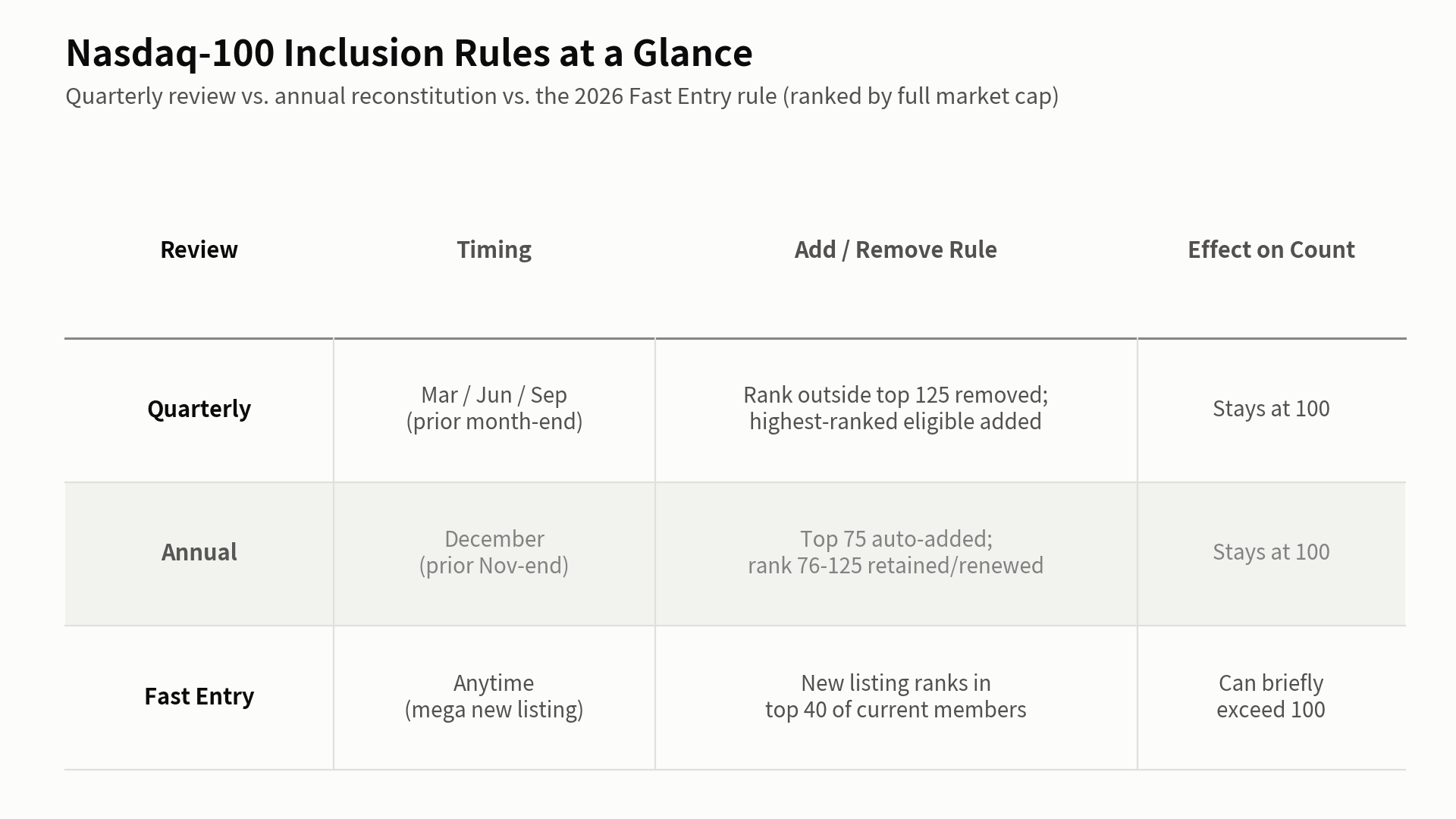
The Nasdaq-100 inclusion rules boil down to one number: full market capitalization rank among non-financial companies primarily listed on Nasdaq. The index gets a light check every quarter (March, June, September) and a heavier overhaul every December. Since May 1, 2026, there’s also a “Fast Entry” path that can add a massive new listing between those scheduled reviews. The ranking logic sounds simple until you notice that the quarterly and annual reviews actually use different cutoffs for who stays and who gets replaced.
What the index is actually built from
Nasdaq-100 constituents are non-financial companies with a primary listing on a Nasdaq-affiliated exchange. Banks, insurers, and other financial companies are excluded from the start, along with REITs, SPACs, and companies in bankruptcy proceedings. A stock also needs at least three full calendar months of trading history and a three-month average daily traded value of at least $5 million.
Every part of the Nasdaq-100 inclusion rules, whether it governs removal, addition, or Fast Entry eligibility, runs on one figure: Full Market Capitalization. That’s share price multiplied by total shares outstanding, not just the free float that some other index providers use. Keep that single number in mind and the rest of the mechanics get much easier to follow.
The quarterly rebalance in March, June, and September
Outside of the December overhaul, Nasdaq-100 rebalances three more times a year, using the last trading day of February, May, and August as reference dates. The rule here is straightforward: any existing constituent whose full-market-cap rank falls outside the top 125 is removed. If that drop pushes the total constituent count below 100, the highest-ranked company not already in the index takes the open seat.
The June 22, 2026 rebalance is a good real-world example. Astera Labs (ALAB), CoreWeave (CRWV), Nebius Group (NBIS), Rocket Lab (RKLB), and Teradyne (TER) were added, while Charter Communications (CHTR), Cognizant (CTSH), Insmed (INSM), Verisk Analytics (VRSK), and Zscaler (ZS) were removed. What makes this list interesting is that Insmed had only joined the index six months earlier, in the December 2025 annual reconstitution. A company’s rank can move that much in half a year.
December’s annual reconstitution runs on a different formula
Nasdaq-100 inclusion rules aren’t the same in December as they are the rest of the year. The annual reconstitution happens each December, timed to the Friday of quadruple witching week, using the last trading day of November as the reference date. It’s a more layered process than the quarterly check.
The annual reconstitution runs in three tiers. Any company ranked in the top 75 by full market cap is added automatically, regardless of whether it was already in the index. Existing constituents ranked 76 to 100 simply stay. Existing constituents ranked 101 to 125 get a second chance to be retained. If those three groups don’t add up to 100 names, the remaining slots go to the next-highest-ranked eligible companies in order. In short, the automatic top-75 tier and the “already in, so you get some slack” 76-125 tier are evaluated by different rules.
The December 22, 2025 reconstitution added Alnylam Pharmaceuticals (ALNY), Ferrovial (FER), Insmed (INSM), Monolithic Power Systems (MPWR), Seagate Technology (STX), and Western Digital (WDC), while removing Biogen (BIIB), CDW (CDW), GlobalFoundries (GFS), Lululemon (LULU), ON Semiconductor (ON), and The Trade Desk (TTD).
What changed with the 2026 Fast Entry rule
What it is: Fast Entry is an exception that lets an unusually large new listing join the Nasdaq-100 without waiting for the next quarterly or annual review.
Why it exists: companies have increasingly stayed private longer and then debuted at a much larger scale, and Nasdaq concluded that waiting months for the next scheduled review understated how these giant new listings should already be represented in the index.
How to read it: to qualify, a new listing’s full market cap has to rank within the top 40 of current Nasdaq-100 constituents — a genuinely high bar, since it means the company would already be large enough to sit among the index’s biggest names.
A concrete detail: eligibility is evaluated through the 15th trading day after listing, with the inclusion decision announced after the close of business on the 10th trading day; the standard seasoning requirement is waived, but the $5 million average daily traded value requirement still applies.
The limitation: because a Fast Entry addition doesn’t require removing another name, the total constituent count can temporarily rise above 100 until the next December reconstitution brings it back to 100.
The rule took effect on May 1, 2026, and the first quarterly rebalance under the new methodology was the June 22, 2026 one described above. That said, there’s no public confirmation that any of the June additions actually used the Fast Entry path — CoreWeave, for instance, had already been trading for more than a year by then (it IPO’d in March 2025), so it more plausibly qualified through the ordinary quarterly review. As of this writing, September 15, 2026, no company’s addition has been publicly attributed to Fast Entry. Even so, Fast Entry is now part of the Nasdaq-100 inclusion rules as the one path that skips the scheduled review calendar entirely.
The weight caps that keep the index from concentrating too far
Ranking by market cap doesn’t automatically prevent the index from leaning too heavily on a handful of giant companies, so separate weight-capping rules apply on top of the ranking.
No single company’s weight can exceed 20%, and the combined weight of all companies individually above 4.5% is capped at 48% (reduced to 40% specifically at the point of quarterly rebalancing). At the security level, no single security can exceed 14%, and the top five securities combined are capped at 38.5%. This is why a stock’s market-cap rank and its actual weight in the index don’t move in exact proportion.
What this means if you hold QQQ or track the Nasdaq-100
Understanding the Nasdaq-100 inclusion rules matters most in practice for how they affect QQQ holders and other index trackers in two ways. First, a newly added stock often sees buying pressure from index funds between the announcement date and the effective date, as trackers adjust their holdings ahead of the change. Second, a stock on its way out can face the opposite pressure over the same window. How much that pressure actually moves the share price depends on the stock’s liquidity and its target weight, and it doesn’t always move in the direction you’d expect.
Fast Entry works differently: it’s not about who gets removed, it’s about how soon a newly public giant shows up in your index fund at all. For QQQ holders, that means exposure to the next mega-IPO could start weeks or months earlier than under the old rules. The next thing to watch is the September 2026 quarterly rebalance. Based on the last-trading-day-of-August reference date, Nasdaq typically announces quarterly changes in the second or third week of September, with the change taking effect the following Monday after the third Friday. The confirmed list will be posted at Nasdaq’s official index site (indexes.nasdaq.com) and Nasdaq Investor Relations (ir.nasdaq.com). That announcement will be the next real test of how the Nasdaq-100 inclusion rules play out in practice.