Vertiv stock dropped 17% in a single day right after its Q2 2026 earnings release on July 29, 2026. Profit beat expectations and the company raised its full-year guidance, yet the stock still fell. The reason: revenue of $3.274 billion missed the roughly $3.38 billion consensus. But there was another notable change buried in the same release. A backlog figure the company had reported every quarter through mid-2025 was missing entirely from this one. Instead, the balance sheet showed customer prepayments nearly doubling in six months. The headline numbers and the numbers hiding underneath were telling two different stories.
What Vertiv stock is really a bet on: power and cooling for AI data centers
Vertiv makes the power backup systems (uninterruptible power supplies) and cooling equipment that go inside data centers. Unlike most industrial companies, it has no aerospace division or general power-grid business to fall back on — data center infrastructure is essentially the whole company. When Microsoft, Amazon, or Alphabet build an AI data center, power and cooling equipment is as essential as the servers themselves, and Vertiv is one of the few public companies with pure exposure to that spending. The upside is a direct line to AI capex growth; the downside is having nothing to fall back on if that spending cycle turns.
Inside the Q2 numbers: strong profit, a soft top line
Second-quarter 2026 revenue came in at $3.274 billion, up 24% year over year (18% organic). Adjusted operating profit rose 44% to $638 million, with adjusted operating margin expanding 410 basis points to 22.6%. Adjusted diluted EPS grew 60% to $1.52, beating the $1.43 consensus estimate. Based on that momentum, management raised full-year 2026 guidance to $13.8–$14.2 billion in revenue and $6.65–$6.75 in adjusted diluted EPS.
On paper, this is a clean beat. The problem wasn’t the growth rate itself but the bar the market had already set. Vertiv stock was trading at 65 times trailing earnings going into the print, and a stock priced that richly doesn’t get much benefit of the doubt on a revenue miss, even with a profit beat attached.
The missing backlog number, and what the balance sheet said instead
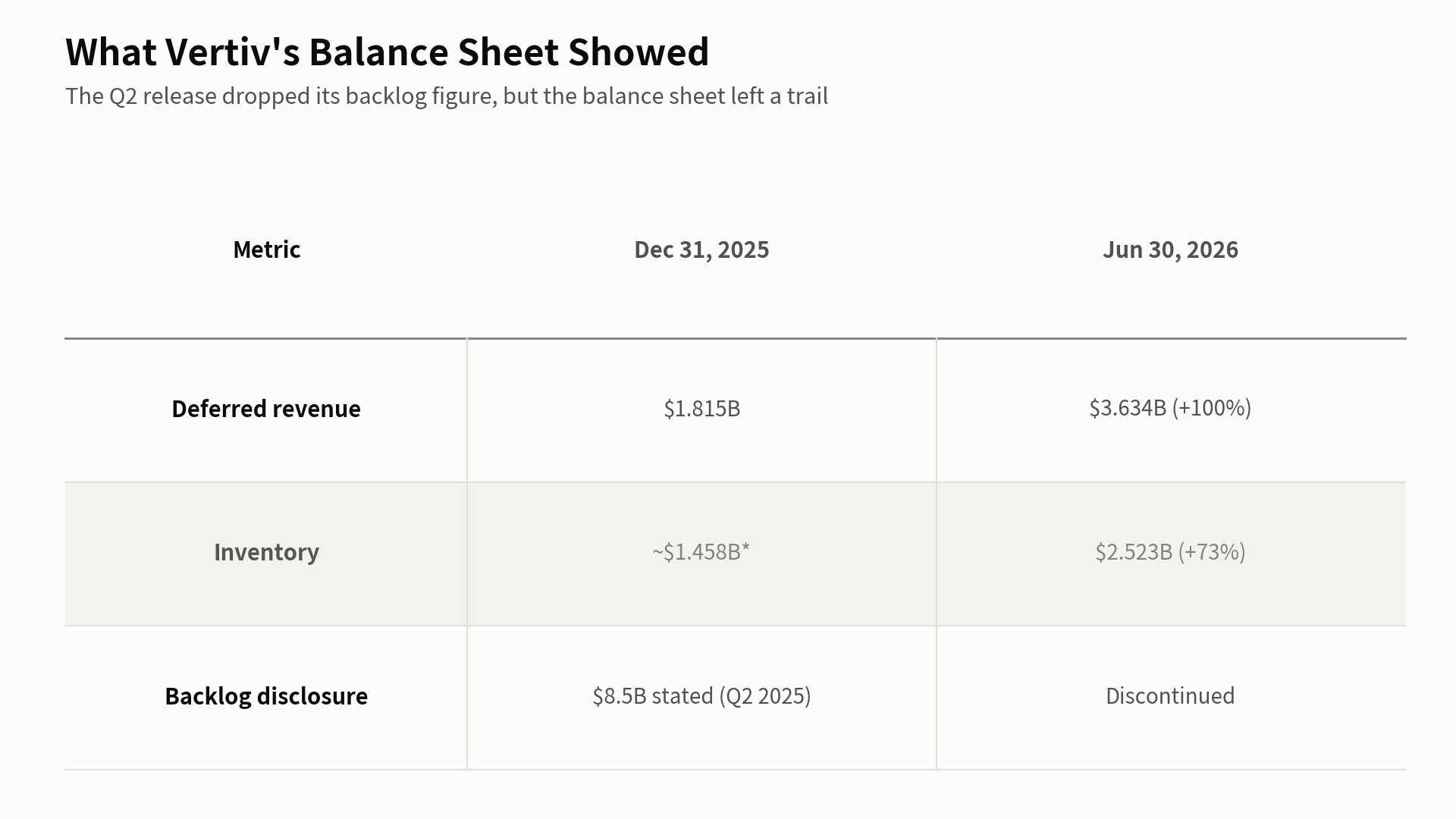
Through Q2 2025, Vertiv’s earnings releases prominently featured a backlog figure — $8.5 billion at that time. The Q2 2026 release included no backlog number and no orders growth figure at all. In their place, management offered only qualitative language about a “strong demand environment” and “growing pipelines.”
That’s where the rest of the balance sheet becomes worth reading closely. Deferred revenue — money customers have already paid as deposits or prepayments that the company hasn’t yet recognized as revenue — nearly doubled, from $1.815 billion at the end of 2025 to $3.634 billion by June 30, 2026. A rising deferred-revenue balance means customers are paying ahead of delivery, which doesn’t fit a demand-slowdown story. Inventory over the same period jumped 73% to $2.523 billion, consistent with the company stockpiling parts and finished goods to meet a growing order book.
That said, these figures aren’t a full substitute for a disclosed backlog number. Rising deferred revenue and inventory are circumstantial evidence, not an official explanation for why the company stopped reporting backlog. Why the disclosure changed at all is itself an open question the next few quarters need to answer.
A regional split: strength in the Americas and Asia, weakness in Europe
The regional breakdown for Q2 shows a clear divide. The Americas grew revenue 29.2% with 21.1% organic growth, and adjusted operating margin expanded 360 basis points to 27.6%. Asia-Pacific was similarly strong, up 28.5% in revenue with 25.7% organic growth. Europe, the Middle East, and Africa (EMEA), by contrast, grew revenue just 1.7% and posted negative 2.4% organic growth. Management attributed this to “temporary supply chain congestion and multi-phased project execution,” but whether that weakness is temporary or reflects a genuine slowdown in the region’s data center spending is something only the next few quarters can confirm.
What today’s Vertiv stock price is asking for
As of the September 15, 2026 close, Vertiv traded at $234.61, with a market cap of $90.32 billion. The trailing P/E sits at 53.1x, while the forward P/E (based on the next twelve months of expected earnings) has come down to 29.9x, well below where it traded before the earnings selloff. That current price is roughly 38% below the 52-week high of $379.94, and about 44% below the average analyst price target of $338.15.
The comparison with Eaton sharpens Vertiv’s position. Eaton is a diversified company spanning electrical infrastructure, aerospace, and data centers, and grew revenue about 10.3% in fiscal 2025, versus Vertiv’s 27.7% growth from its singular data center focus. That diversification comes with a lower valuation — Eaton traded around a 30x forward P/E and 5.7x price-to-sales as of June 2026, while Vertiv commanded a premium for its higher growth (that comparison predates Vertiv’s post-earnings pullback, so the valuation gap between the two has since narrowed). The tradeoff is straightforward: Vertiv is the more direct beneficiary as long as AI data center spending keeps climbing, but unlike Eaton, it has no other business to lean on if that cycle slows.
What to watch next
Two things need to hold up for the current Vertiv stock valuation to make sense. First, whether Q3 revenue clears consensus again, and how quickly that rising deferred-revenue balance converts into recognized sales. Second, whether EMEA’s organic decline turns out to be the temporary supply-chain issue management described, or an early sign that data center investment is cooling in that region. Management’s own guidance implies second-half revenue of roughly $8.08 billion, about 36% above the first half — a concrete target the next couple of earnings reports will either confirm or contradict. The underlying figures are available directly on Vertiv’s official investor relations page (investors.vertiv.com).