Netflix stock closed at $77.90 on September 15, down 38% from its 52-week high of $124.86. It trades at a trailing P/E of 24.55 and a forward P/E of 22.49. This isn’t really a story about deteriorating earnings — it’s the combined weight of co-founder Reed Hastings’ board departure, worries about slowing per-subscriber viewing time, the risk of AI disrupting content production, and intensifying competition. This piece checks whether Netflix stock is now an attractive entry point or whether the sell-off has legitimate grounds, using Q2 earnings and the company’s expanding ad business as evidence.
Why Reed Hastings leaving the board rattled Netflix stock
Netflix co-founder and board chair Reed Hastings announced in April that he would not seek re-election when his current board term ends in June. Netflix stock fell roughly 10% from the prior close the day after the news broke. Hastings said he wanted to focus on philanthropy and other pursuits, and the company praised his role in building Netflix’s culture of innovation and integrity. Co-CEOs Ted Sarandos and Greg Peters remain in charge, but the symbolic end of the founder era was enough to unsettle investors.
Q2 earnings: revenue growth continued, but margin slipped slightly
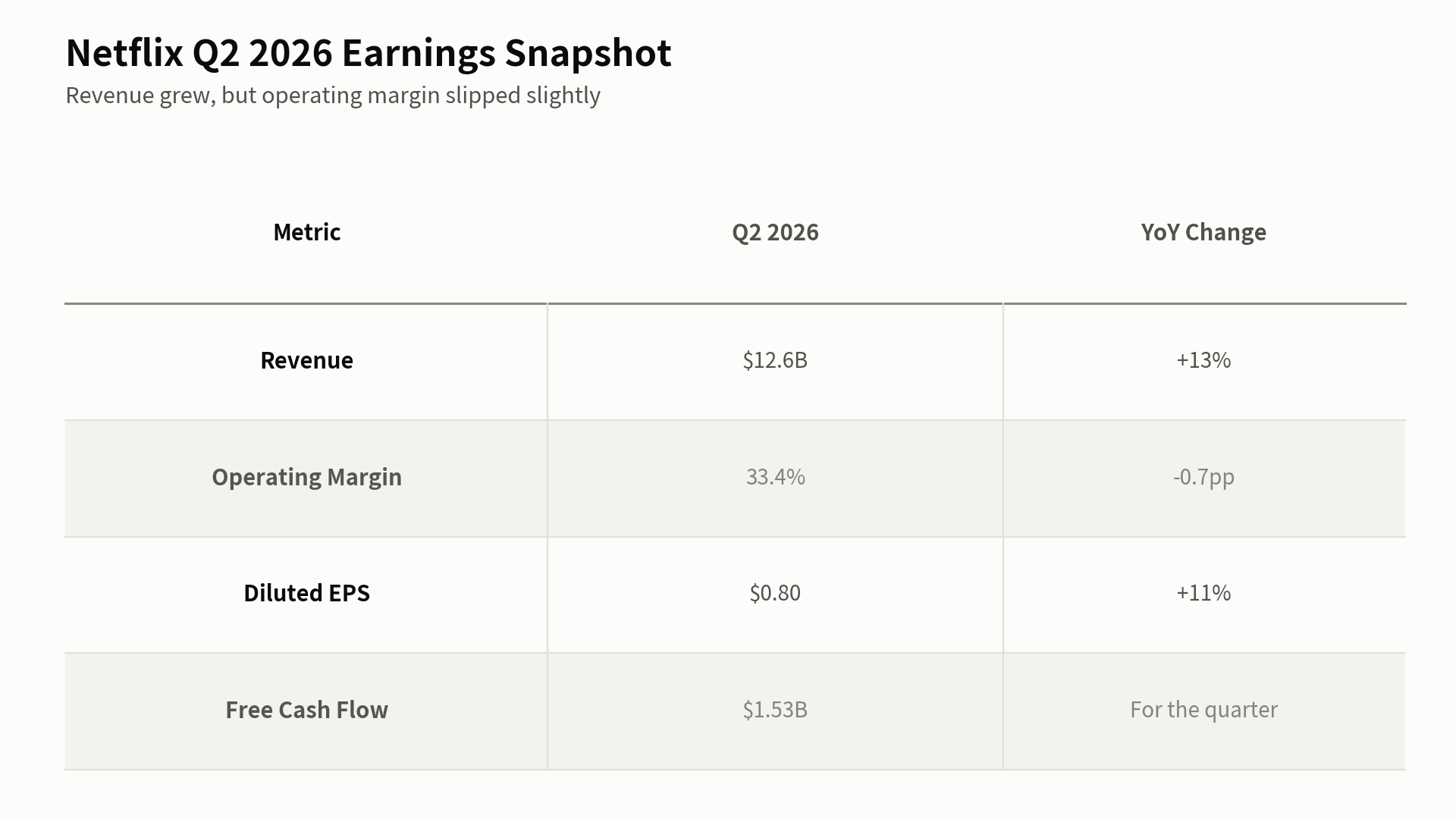
Netflix’s Q2 2026 revenue came in at $12.6 billion, up 13% year over year (12% on a currency-neutral basis). Operating margin was 33.4%, down slightly from 34.1% a year earlier. Diluted EPS grew 11% to $0.80, net income was $3.4 billion, and free cash flow reached $1.5 billion.
Netflix narrowed its full-year revenue guidance to a range of $51.0 billion to $51.4 billion, implying 13% to 14% growth, while keeping its full-year operating margin target at 31.5%. Even so, Q3 guidance called for revenue of $12.9 billion and 12% growth (11% currency-neutral) — a deceleration from Q2’s pace — and Netflix stock fell after that guidance was released, even though the quarter itself matched expectations.
Viewing hours are up, so why the engagement concerns?
Bank of America analyst Jessica Reif Ehrlich cited three overlapping concerns behind the 2026 decline in Netflix stock: per-subscriber viewing hours declining year over year, the risk that AI could disrupt the economics of content production, and heightened competition from media M&A activity along with YouTube and short-form video platforms.
What’s notable is that this concern doesn’t line up cleanly with what Netflix itself disclosed. In its Q2 shareholder letter, the company said total view hours grew 2% year over year in the first half of 2026, actually faster than 2025’s full-year growth rate of 1.5%. But that figure is aggregated across all members, so if the subscriber base is growing faster than total viewing hours, per-subscriber viewing time can still be falling even as the company-wide total rises. Aggregate and per-user metrics can tell different stories, and treating them as interchangeable is a common way to misread the data.
The advertising business, meanwhile, keeps scaling fast. Netflix said its ad-supported tier surpassed 250 million monthly active viewers as of its May upfront presentation, up sharply from 190 million in November 2025. The company expects full-year ad revenue to roughly double from 2025 to about $3 billion. Netflix also said it’s expanding AI-powered advertising tools and automating programmatic buying to broaden its advertiser base.
Where does Netflix stock sit against the consensus
Across 51 analysts tracked by Stock Analysis, the consensus rating on Netflix stock is “Buy,” with an average price target of $93.88 — roughly 20.5% above the current price. Even Bank of America, despite flagging those three concerns, kept a Buy rating and a $125 price target, pointing to how Netflix rebounded from similar skepticism in 2022-2023 through password-sharing crackdowns and its ad-supported tier.
The strongest counterargument: competition and AI risk aren’t showing up in the numbers yet
The core pushback is that these concerns haven’t yet shown up in revenue or profit. Worries about rivals gaining scale through media M&A and about YouTube and short-form platforms eating into viewing time are reasonable, but Netflix’s Q2 revenue growth of 13% and operating margin of 33.4% don’t yet show evidence that this pressure has hit the actual results. Whether AI will structurally lower content production costs or instead raise costs tied to copyright and quality control is still unclear either way. That said, the drop in Q3 revenue growth guidance to 12% from Q2’s pace is a signal that these concerns may be starting to show up in the numbers, even if only modestly.
What to watch next
The first thing to track is whether Q3 2026 earnings, expected around October, land near the guided 12% revenue growth or decelerate further. Second, watch whether ad revenue is actually tracking toward the $3 billion full-year target, and whether the 250 million ad-tier viewers translate into rising ad prices (CPMs). Third, keep an eye on whether rising content costs from expanded live sports rights, including NFL games, put pressure on the 31.5% operating margin target. The full Q2 results are available in Netflix’s official shareholder letter.